
Soups & Stews
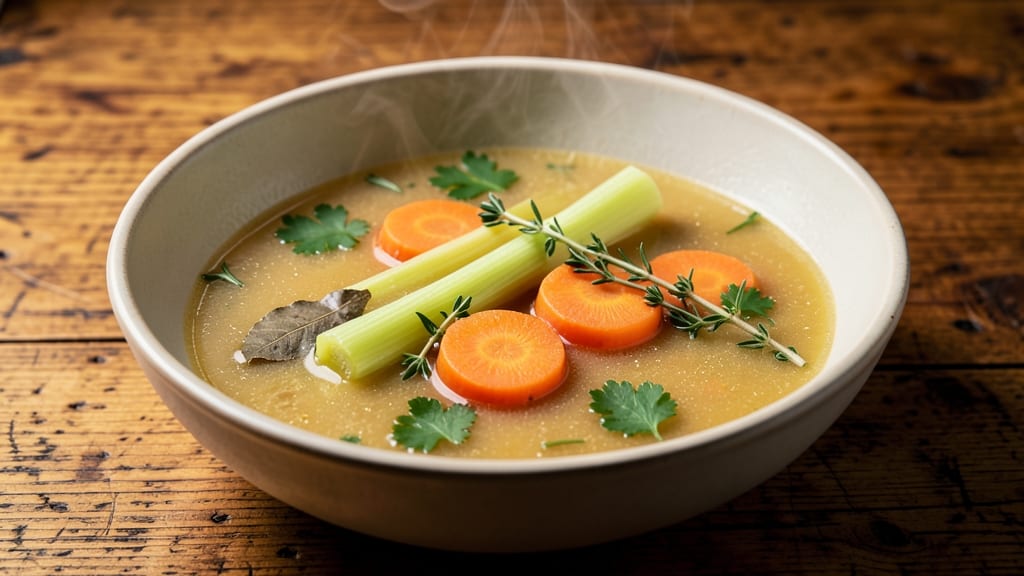
Making chicken broth without onion or garlic doesn’t mean sacrificing flavor—it just means getting creative with herbs and aromatic vegetables. I grew up in small-town Georgia where my grandma always swore by a clear, herb-packed broth that built flavor without relying on onion or garlic.
That same philosophy is what makes this recipe work so well.
The secret lies in a trio of classic vegetables—celery, carrots, and a bay leaf—that form the backbone of flavor, while fresh thyme and parsley add bright, herbal notes.
Simmering everything for 2 hours extracts maximum depth without clouding the broth, and straining carefully ensures you’re left with a crystal-clear liquid that’s perfect for soups, risottos, or braising.
What you’ll end up with is a light, clean broth that’s packed with subtle herbal complexity—no overpowering aromas, just pure, adaptable flavor. It’s the kind of broth that makes even simple recipes taste elevated, and it keeps beautifully in the fridge for up to 5 days or freezes for months.
This isn’t just a broth substitute—it’s a blank canvas for your cooking, ready to absorb whatever you toss into it next. Let’s get started!
Ingredients for chicken broth without onion or garlic
Herb-forward, onion-free, garlic-free ingredients that build deep flavor through slow simmering.
| Ingredient | Amount | Notes |
|---|---|---|
| Chicken Carcasses 🍗 | 2 lb | Raw, with giblets removed |
| Celery Stalks 🧅 | 4 whole | Fresh, tough strings removed |
| Carrots 🥕 | 3 whole | Medium, peeled and chopped |
| Fresh Thyme Sprigs 🌿 | 4 sprigs | Or 1 tbsp dried thyme |
| Fresh Parsley Sprigs 🌿 | 2 sprigs | Stems included for flavor |
| Bay Leaves 🍃 | 2 whole | Dried, standard size |
| Black Peppercorns 🌶️ | 1 tsp | Crushed, not ground |
| Salt 🧂 | 1 tsp | Kosher or sea salt |
| Cold Water 💧 | 8 cups | Filtered preferred |
The chicken carcasses are the flavor foundation—Costco or butcher shops often have them for cheap, but any raw chicken bones work. Look for bones with some meat still attached for extra richness. Fresh thyme and parsley are non-negotiable here—they carry the herbal brightness. Whole Foods or local farmers markets usually have the freshest bundles. If you can't find fresh thyme, dried works at one-third the amount, but fresh is always better. The carrots and celery should be vibrant, not wilted or rubbery—organic produce often has better flavor. For bay leaves, grab the dried ones from the spice aisle—they're more potent and keep longer.
No fresh herbs? Dried oregano or marjoram can step in, but reduce to half the amount. Short on carrots? Leeks or fennel add sweetness without onion. The peppercorns should be freshly crushed—a mortar and pestle works best, but a clean spice grinder does too. Salt is simple, but Diamond Crystal kosher salt dissolves better than table salt. For the water, filtered or spring water prevents off-flavors, but tap water works fine if you boil it first. The key is letting everything simmer low and slow—no rushing—to extract maximum flavor without clouding the broth.
This broth stays crystal clear when strained through a fine-mesh sieve or cheesecloth. Store it in the fridge for up to 5 days or freeze in ice cube trays for up to 6 months. I always make extra—freeze portions in 1-cup increments for easy use. The flavor actually improves after a few days in the fridge, so don't hesitate to make a big batch. For best results, let it cool completely before refrigerating to prevent skin formation.
Why You'll Love This Recipe
- No-Skip Simmering: Honestly, this broth is that kind of recipe where you can prep everything in 15 minutes flat—just rinse those chicken carcasses, chop the celery and carrots into even chunks, and toss everything in. No fancy prep, no standing over the stove for hours. The cold water start and gentle simmer do all the heavy lifting while you’re doing something else.
- Thyme-Scented Magic: Between the fresh thyme and parsley, plus those bay leaves and peppercorns, this broth gets this deep, aromatic kick without relying on onion or garlic. The celery and carrots add a subtle sweetness that balances the savory bones perfectly—like a warm hug in a bowl. I’ll be real: it’s the kind of flavor that makes even plain rice taste like a meal.
- Freezer’s Best Friend: I freeze half of every batch in ice cube trays because, let’s face it, you will forget to use it otherwise. Those cubes are perfect for deglazing pans, simmering grains, or even boosting instant pot meals. And since it keeps for six months? That’s six months of never having to buy store-bought broth again.
- Budget’s Secret Weapon: Two pounds of chicken carcasses usually cost me less than a gallon of pre-made broth, and it yields way more. Plus, those veggie scraps and herb sprigs are pantry staples you probably already have. It’s the kind of recipe that stretches your dollars while still making your kitchen smell like heaven. Win-win.
Step-by-step instructions for herb-infused chicken broth
Here's how to craft a vibrant, aromatic broth using just the right balance of herbs and vegetables.
Prepare the Chicken Carcasses and Vegetables
Begin by thoroughly rinsing the 2 lb chicken carcasses under cold water to remove any residual blood or debris. Pat them dry with paper towels—this ensures a cleaner broth without cloudiness. Next, cut the 4 whole celery stalks into 2-inch pieces and peel the 3 whole carrots before chopping them into similarly sized chunks. The uniform pieces will extract flavor evenly during simmering.
Real talk: Don't skip the rinsing step. Any lingering blood or bone fragments can make your broth bitter or cloudy. I like to work in batches if I'm making multiple batches, but for this recipe, one pot will do just fine. Keep everything prepped and ready to go—this is your mise en place for a perfect broth.
Simmer the Broth with Herbs and Spices
In a large stockpot, combine the prepped chicken carcasses, celery, carrots, 4 sprigs fresh thyme, 2 sprigs fresh parsley, 2 whole bay leaves, 1 tsp crushed black peppercorns, and 1 tsp salt. Add the 8 cups cold water, ensuring all ingredients are fully submerged. The cold water helps prevent the herbs from releasing bitterness too quickly.
Place the pot over medium-high heat and bring the mixture to a rolling boil. Once boiling, reduce the heat to low and maintain a gentle simmer. Here's the thing—you want to see small bubbles breaking the surface, but not a vigorous boil. This low-and-slow approach extracts the maximum flavor without breaking down the collagen in the bones too quickly.
Skim and Simmer for Clarity
After 30 minutes, carefully skim any foam or impurities that rise to the surface using a fine-mesh skimmer or ladle. This step is crucial for achieving a clear, golden broth. I like to do this every 15-20 minutes during the first hour to keep the broth pristine. The foam contains impurities that can cloud the final product.
Continue simmering uncovered for a total of 3-4 hours. The longer simmering time allows the collagen in the bones and connective tissue to break down into gelatin, which gives your broth that silky, velvety texture. You'll know it's ready when the broth has a deep, rich color and the chicken bones are falling apart easily when tested with tongs.
Strain and Finish the Broth
Once the broth is fully developed, remove the pot from the heat and let it sit for 10 minutes to allow any remaining solids to settle. Line a fine-mesh strainer with cheesecloth or a coffee filter if you want an especially clear broth. Slowly pour the broth through the strainer into a clean container, pressing gently on the solids to extract every last drop of flavor.
Taste the broth and adjust the seasoning if needed. You might find it needs a touch more 1 tsp salt or a splash of 8 cups cold water to reach your desired consistency. Let it cool to room temperature before refrigerating. The broth will continue to develop flavor as it chills, and any fat will solidify on top, making it easy to remove before use.
Pro Tips For Making Chicken Broth Without Onion Or Garlic
- Start Cold, Stay Patient: Cold water isn’t just a suggestion—it’s the difference between bitter broth and golden perfection. I used to rush the boil with hot water, and the thyme and parsley would release bitterness immediately. Let the cold water (8 cups, filtered if you’re fancy) bring the pot to a boil first, then simmer low. The slow extraction is what turns tough bones into silky goodness.
- Crush Peppercorns Properly: That 1 tsp of black peppercorns isn’t just for show—it needs to be crushed, not ground. Whole peppercorns float uselessly, and pre-ground pepper loses its punch. Use the flat side of a heavy knife or a mortar and pestle to smash them just enough to release their oils. This isn’t the prettiest method, but it’s the tastiest.
- Test Bones, Not Time: The recipe says 3-4 hours, but bones lie. After 2.5 hours, use tongs to pull out a bone—if it crumbles easily when poked, the broth is ready. If it resists, give it another 30 minutes. I’ve burned broth waiting for the clock, only to find the bones still stubborn. Trust the bones, not the timer.
- Strain Twice for Clarity: One strainer pass won’t cut it. After the 10-minute settle, line your fine-mesh strainer with cheesecloth or a coffee filter for a second strain. It’s extra effort, but the difference between murky broth and crystal-clear gold is worth it. (Yes, even if you’re impatient like me.)
Essential equipment for perfect results
Your Trusty Stockpot
You don’t need fancy equipment for this broth—just a large, heavy-bottomed stockpot. I swear by my Lodge 8-quart cast iron because it distributes heat evenly and handles long simmers like a champ.
If you don’t have cast iron, a stainless steel stockpot from Le Creuset or All-Clad works too. Avoid nonstick—it can’t handle the high heat needed for clarity. 🔥
Fine-Mesh Skimmer
A fine-mesh skimmer is non-negotiable for removing foam during the first hour. I use the OXO Good Grips one—it’s got a long handle and a tight weave that catches every last bit of impurities.
If you don’t have one, a slotted spoon works in a pinch, but you’ll miss some of the foam. Trust me, that foam hides bitterness.
Cheesecloth or Coffee Filter
For crystal-clear broth, line your strainer with cheesecloth or a coffee filter. I keep a roll of organic cheesecloth from Amazon on hand—it’s cheap and does the job perfectly.
If you’re in a hurry, a clean kitchen towel works, but it won’t strain as finely. Press the solids gently to extract every last drop of flavor.
Instant-Read Thermometer
While you’re simmering, a thermometer helps you monitor the broth’s temperature. I use the Thermoworks Smoke because it’s durable and accurate. Keep an eye on the heat—you want a gentle simmer, not a rolling boil.
If the broth gets too hot, the collagen breaks down too fast, and you’ll end up with a cloudy mess.
Fine-Mesh Strainer or Sieve
The fine-mesh strainer is where the magic happens. I have a stainless steel one from Cuisinart that’s my go-to for broth. It’s wider than a regular colander, so it catches more solids.
If you’re on a budget, a mesh tea strainer works in a pinch—just line it with cheesecloth for extra clarity. Don’t skip this step!
Digital Scale (Optional)
If you’re feeling fancy, a digital kitchen scale helps you measure your ingredients precisely. I use the OXO Good Grips one for broth because it’s accurate and easy to read.
But honestly, you don’t need it—just chop your veggies evenly, and you’ll be fine. The key is consistency in size, not exact weight.
Nutrition facts
Frequently asked questions
Why skip onion and garlic in chicken broth?
Onion and garlic can overpower the subtle herbal notes in this broth, especially when you're using delicate ingredients like thyme and parsley. Skipping them lets the natural sweetness of carrots and celery shine while keeping the flavor profile clean and versatile for dishes where onion/garlic might not be desired.
Can I use dried herbs instead of fresh?
Yes, but adjust the amounts! Replace 4 sprigs fresh thyme with 1 tbsp dried thyme and halve other fresh herbs like parsley. Dried herbs are more concentrated, so they'll release flavor faster. The broth will still be aromatic, just with a slightly different texture.
What if my broth turns cloudy?
Cloudiness usually happens if you boil too vigorously or don't skim properly. For this recipe, maintain a gentle simmer and skim foam every 15-20 minutes during the first hour. If it's already cloudy, strain through cheesecloth for extra clarity—it'll make a big difference!
How do I know when the broth is fully cooked?
Your broth is ready when it's been simmering for 3-4 hours total, the chicken bones fall apart easily with tongs, and the liquid has a deep golden color. The longer simmering breaks down collagen into gelatin, giving your broth that silky texture you want for soups or sauces.